All 36 archaeological sites in Efrîn damaged, says Bettal Xelil
What happened?
All 36 officially registered archaeological sites in the region, part of Aleppo province in (), have been damaged, Efrîn Director of Antiquities Bettal Xelil announced. Ayman Nabo, Syria's deputy director-general of antiquities, said the number of historical artefacts seized or recorded across the country had exceeded 100,000.
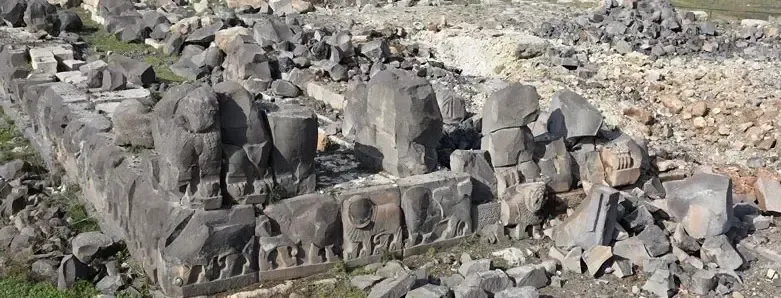
Xelil said uncontrolled excavations had been carried out at Nebi Huri and the Ayn Dara Temple. He said both sites had suffered serious destruction. Xelil noted that illegal digging had also taken place on Mount Şeran, which is of historical value.
According to Nabo, the large-scale destruction mostly involved heavy machinery, earth-moving vehicles and advanced excavation equipment. Nabo argued that this showed the digging had been organised.
Xelil announced that more than 50 valuable artefacts had been collected from Şeran and Bilbil together with the local administration and security forces. According to Xelil, these artefacts were safely handed over to the Aleppo Museum. Xelil also described artefacts recently found in the village of Marsawa. They include ceramic vessels, iron candlesticks, a stone monument, a damaged statue of a woman and marble columns. Xelil said the artefacts had been recorded and moved to the special storage facility in Ayn Dara.
According to Xelil, work is now focused on three areas: rehabilitating the damaged sites, clearing debris and soil, and documenting the destruction. "A stronger awareness has now emerged of the need to protect and respect these historical sites," Xelil said.
Nabo said the destruction was very extensive, although no detailed and precise inventory exists yet. Nabo's initial estimates are as follows (the figure for is approximate):
| Idlib | 70 |
|---|---|
| Hesekê | 60 |
| Hama | 30 |
| Homs | 20 |
According to Nabo, the damage at a single site can also range from 10 percent to 80 percent. Several factors were cited as causes of the destruction. One is the direct bombardment by warplanes of areas under opposition control. Others are illegal excavations and the breaking up of stones for sale. Refugee camps set up at or near historical sites also caused destruction. Unplanned construction and neglect during the long years of war were also named among the main causes.
Nabo noted that the number of seized artefacts keeps changing. They include ceramic fragments, ancient coins, statues and mosaics. Some of the artefacts were handed over voluntarily by citizens. Most, however, were seized in coordination with security units. These artefacts were intercepted at airports, inside Syria and abroad during smuggling attempts.
Nabo announced that the Directorate-General of Antiquities and Museums had drawn up a plan of about 55 projects for 2026. The plan was prepared together with a number of local and international institutions. The status of the projects was reported as follows:
| Completed | 10 |
|---|---|
| In final implementation stage | 16 |
| File and study ready | 19 |
| In initial study stage | 10 |
Major projects are being carried out with support from the directorate's budget and in cooperation with institutions. These include the European Institute of Cooperation and Development, the Aga Khan Foundation, the United Nations Development Programme (UNDP) and UNESCO. The list also includes the Ministry of Tourism, the Mar Ephrem Patriarchal Development Committee and Terre des Hommes.