Syrian demining teams sweep Damascus-Deir ez-Zor road
What happened?
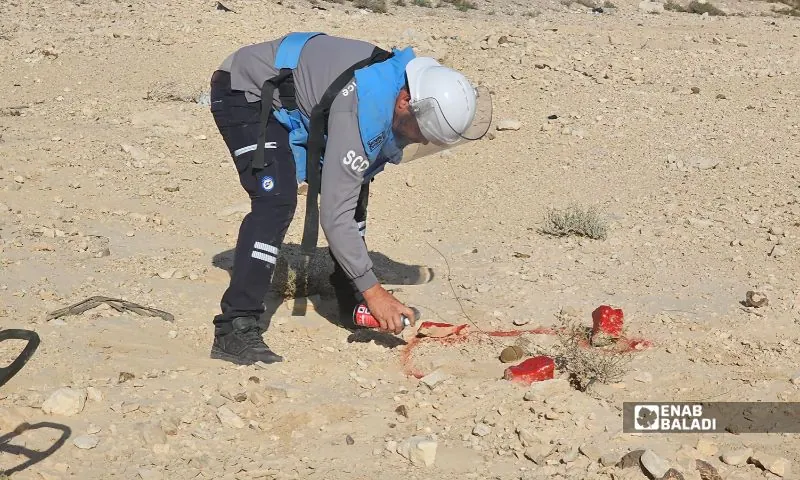
A demining team from Syria's Ministry of Emergency and Disaster Management said it was sweeping the Damascus-Palmyra-Deir ez-Zor road. The road connects the Syrian capital Damascus with the city of Deir ez-Zor via Palmyra, in Homs province. The work aims to make both sides of the road safe and to ease vehicle traffic.
According to the team's statement, most of the war remnants found so far are cluster bombs and hand grenades. The team said the work was being carried out in coordination between the Ministry of Emergency and Disaster Management and the Ministry of Transport.
Hasan Talfah, director of the Damascus and Countryside Ordnance Clearance Centre, said a 100-metre strip on each side of the road was being searched to a depth of 15 centimetres. Depending on the density of ordnance, the teams advance two to three kilometres a day, and sometimes five, according to Talfah. He said the teams had spent three days in some areas no longer than 450 metres. He added that the Palmyra-Deir ez-Zor road was contaminated with dense minefields. According to Talfah, the biggest challenge is flooding. The floods have swept large quantities of ordnance into other areas and buried some mines deeper.
Anas Ramadan, leader of the Damascus and Countryside Mine Team, said the whole team comes to a complete stop whenever a suspicious object is spotted. Ramadan said the team had found artillery shells, hand grenades and cluster bombs, the most dangerous being the cluster bombs. According to Ramadan, the team has not yet come across any mines. However, information provided by local residents suggests there may be many mines on other sections of the road.
The Syrian Ministry of Defence said its Engineering Directorate had detected and cleared more than 315,000 mines and items of unexploded ordnance left over from the former regime. The ministry's Media and Communication Directorate said on 11 November 2026 that the work covered the Jazira region, Damascus, Aleppo and Idlib, as well as the countryside of Homs, Hama and Latakia. According to the directorate, priority is being given in particular to residential and agricultural areas to which people have returned after years away.