Kurdistan Region administration calls for implementation of Şingal agreement
What happened?
Nearly five years have passed since the agreement on , a district of province, was signed. Even so, a significant portion of Ezidi Kurds are still living in camps in the Kurdistan Region.
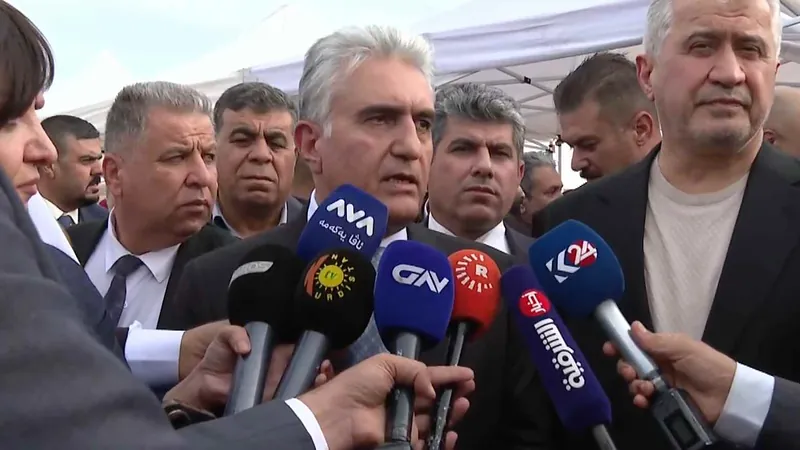
Kurdistan Region Interior Minister Rêber Ahmed made a statement to the press on Saturday, October 24. Ahmed said he was concerned that implementation of the agreement had stalled. He said the time had come to end the suffering of the people of Şingal, and that all obstacles to their return home must be removed. He also asked the Ninova provincial administration for cooperation on basic services and reconstruction.
According to Ahmed, good progress has been made in talks to choose a new district administrator for Şingal. The minister said this step would make reconstruction and the dignified return of the displaced possible. He also said he hoped the federal government would take concrete steps.
ISIS attacked the city of Şingal and its surroundings on August 3, 2014. Most residents took refuge in the Kurdistan Region. The population of Şingal, 130 kilometres from Mosul, the capital of Ninova province, is overwhelmingly made up of Ezidi Kurds. Peshmerga forces liberated the city from ISIS on November 13, 2015, under the direct command of Kurdistan Democratic Party (KDP) KDP President Masoud Barzani. Afterwards, the presence of groups affiliated with the Popular Mobilization Forces (PMF) and of the Kurdistan Workers' Party (Partiya Karkerên Kurdistanê, PKK) made returns difficult.
The agreement was signed on October 9, 2020, at the proposal of the Kurdistan Regional Government (KRG). The agreement between , the capital of the Kurdistan Region, and Baghdad was signed under the supervision of the United Nations (UN). It was signed by Rêber Ahmed and Hamid Rashid, deputy head of the Iraqi National Security Service. The agreement rests on four pillars: administration, security, reconstruction and monitoring of implementation. Its main provisions are: - Recruitment of 2,500 police officers from the local population - Handover of the security file to local forces under the supervision of Baghdad and Hewlêr - Withdrawal of the PKK and PMF-affiliated groups from the area - Provision of municipal services - Appointment of a local district administrator agreed upon by both sides - Establishment of a joint reconstruction committee under UN supervision
Iraqi Prime Minister Ali Zaidi has decided that weapons must be a state monopoly. In Turkey, meanwhile, a process is under way that the Turkish government calls "Terror-Free Turkey" and that the Peoples' Equality and Democracy Party (DEM Party) has also endorsed. Kurdistan24 wrote that the PKK's disarmament under this decision and process could bring the problem of armed groups in Şingal closer to a resolution.