Tom Barrack offered to mediate between Hewlêr and Baghdad, source says
What happened?
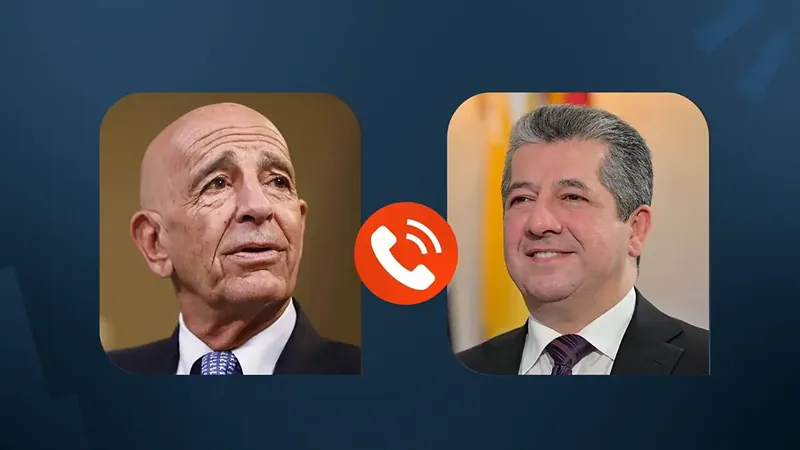
Kurdistan Region Prime Minister Masrour Barzani and Tom Barrack, the US representative for Iraq and Syria, spoke by phone on Wednesday, November 25, according to an unnamed source who spoke to Rudaw. The source said Barrack offered to mediate between Baghdad and , the capital of the Kurdistan Region, to resolve the latest disputes.
Sources in Hewlêr and Baghdad said Barrack also asked Iraqi Prime Minister Ali al-Zaidi to rule out military options. Zaidi is seeking to take over oil fields and border crossings belonging to the Kurdistan Region. "The US government told the Iraqi prime minister not to resort to military options as he did in Jurf al-Sakhar," one source said.
Peshmerga forces have been mobilised along the borders of the disputed provinces. Footage obtained shows armoured vehicles and heavy weapons leaving Hewlêr. The vehicles are being deployed to the borders with and provinces.
On Tuesday, November 24, Zaidi instructed federal authorities to take control of Kurdish-protected oil fields in Nineveh, Kerkûk, Salahaddin and Diyala. He tasked federal institutions with monitoring oil exports and border crossings in the region. He notified the Kurdistan Regional Government (Hikûmeta Herêma Kurdistanê, KRG) that it must not export oil without the approval of the federal Ministry of Oil. Iraq's Federal Supreme Court upheld these instructions on November 25, following an interpretation request filed by Zaidi.
The Kurdistan Democratic Party (Partiya Demokrat a Kurdistanê, KDP) and the Patriotic Union of Kurdistan (Yekêtiya Nîştimanî ya Kurdistanê, PUK) took a joint stance despite their dispute over forming a government. The two parties issued a joint statement on November 24. They called for dialogue and described the weakening of the region's federal rights as a "red line."
PUK spokesperson Karwan Gaznayi said his party was "ready to join hands with all sides to protect the existence of the Kurdistan Region." Gaznayi noted, however, that their disputes with the KDP were a separate matter. Gaznayi set as a precondition the reversal of the Kurdistan Parliament's reactivation earlier in November. He also demanded the dismissal of lawmakers who broke from the party and attended the session.
Iraqi state forces entered the town of Jurf al-Sakhar, south of Baghdad, on Friday, November 20. The town had been under the control of Iran-backed Kataib Hezbollah for 12 years. The operation was launched because the group had been stealing oil from pipelines. Two smuggling networks were subsequently dismantled in Najaf and Dhi Qar provinces.
Iraq's official news agency published a leaked report on November 24. The report pointed to oil being smuggled by road tankers via Iran to Afghanistan, and also to Turkey. Zaidi said he was determined to stop smuggling "from Zaho to Faw." The real trigger for the decision, however, was an investigation into the North Oil Company, which manages oil production in the north.
Kurdish authorities have not confirmed the accuracy of the report. KDP President Masoud Barzani said they were ready to cooperate with federal authorities through "legal and constitutional channels."